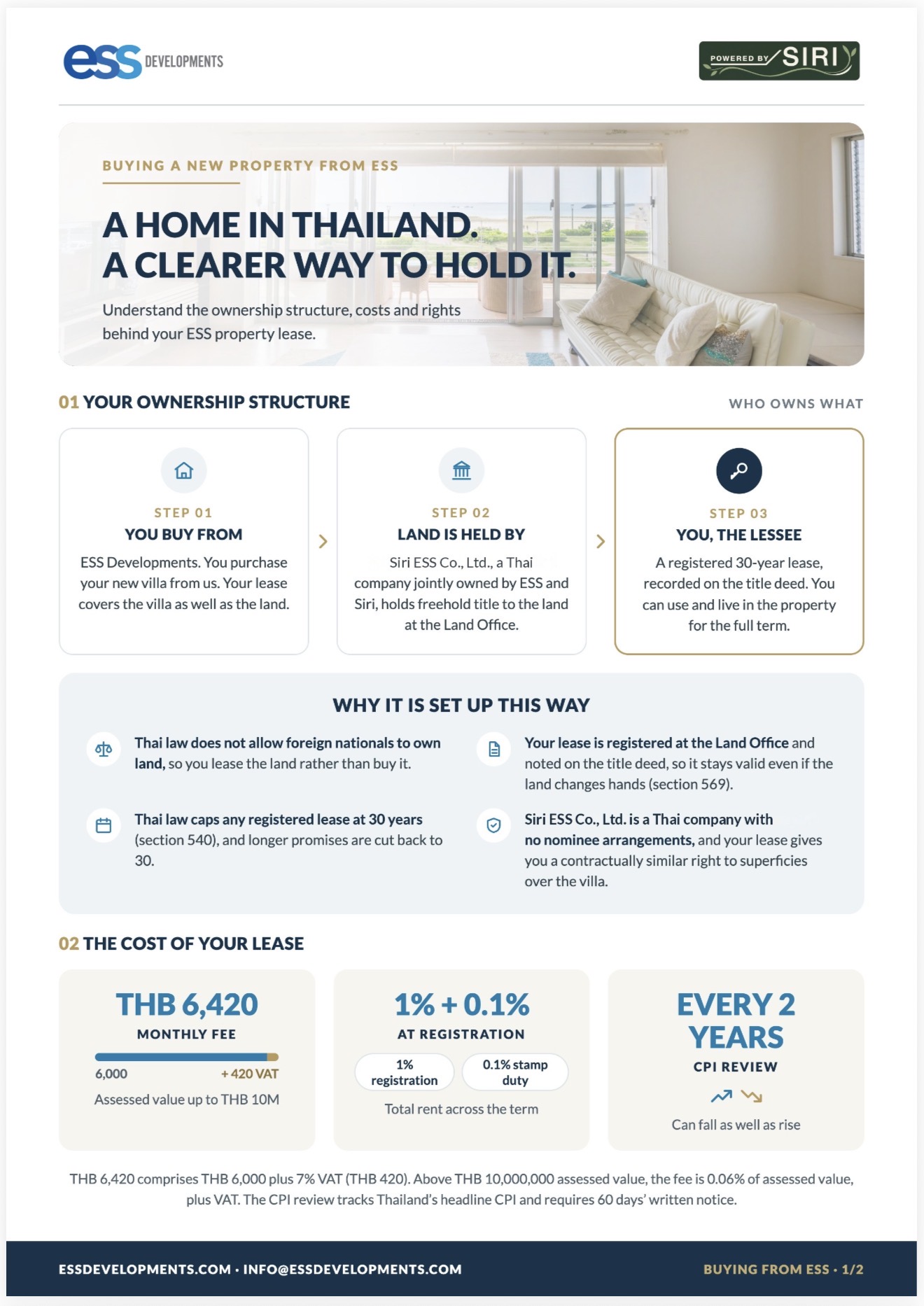
A home in Thailand, a clearer way to hold it. The ownership structure, costs and rights behind your ESS property lease, explained in plain language.
Thai law does not allow foreign nationals to own land, so a villa in Thailand is held on a registered lease. ESS Developments has partnered with Siri, a 100% Thai-owned entity, to deliver a registered leasehold structure held in your own name at the Land Office. The land is held by Siri ESS Co., Ltd., a Thai company jointly owned by ESS and Siri, with no nominee arrangements of any kind. This guide explains how a 30 year lease works in Thailand, what it costs and what happens at the end of the term.
ESS Developments. You purchase your new villa from us. Your lease covers the villa as well as the land.
Siri ESS Co., Ltd., a 100% Thai-owned company jointly owned by ESS and Siri, which holds the registered freehold title to the land.
A registered 30 year lease, recorded on the title deed. You can use and live in the property for the full term.
Thai law caps any registered lease at 30 years (section 540), and longer promises are cut back to 30. Your lease is registered at the Land Office and irrevocably noted on the title deed.
THB 6,000 plus 7% VAT, assessed value up to THB 10,000,000. Above that, 0.06% of assessed value plus VAT.
1% of total rent across the term plus 0.1% stamp duty, paid at the Land Office.
Tracks Thailand’s headline CPI with 60 days written notice. Can fall as well as rise.
Payment is annually in advance as standard. Quarterly payment adds 10% and monthly payment adds 15%.
Held by us as security for your obligations under the lease. Deductions cover only amounts you owe under the lease. Returned when the lease ends, or earlier on purchase, compulsory acquisition or our breach; ask us for the figures that apply to your property.
We handle structural repairs to the original building within its statutory construction warranty period. You handle routine maintenance and insure at full rebuild value. Utilities are paid by you direct, with any village or juristic fees; land and building tax is paid by you each tax year, reimbursed to us within 30 days if assessed to us.
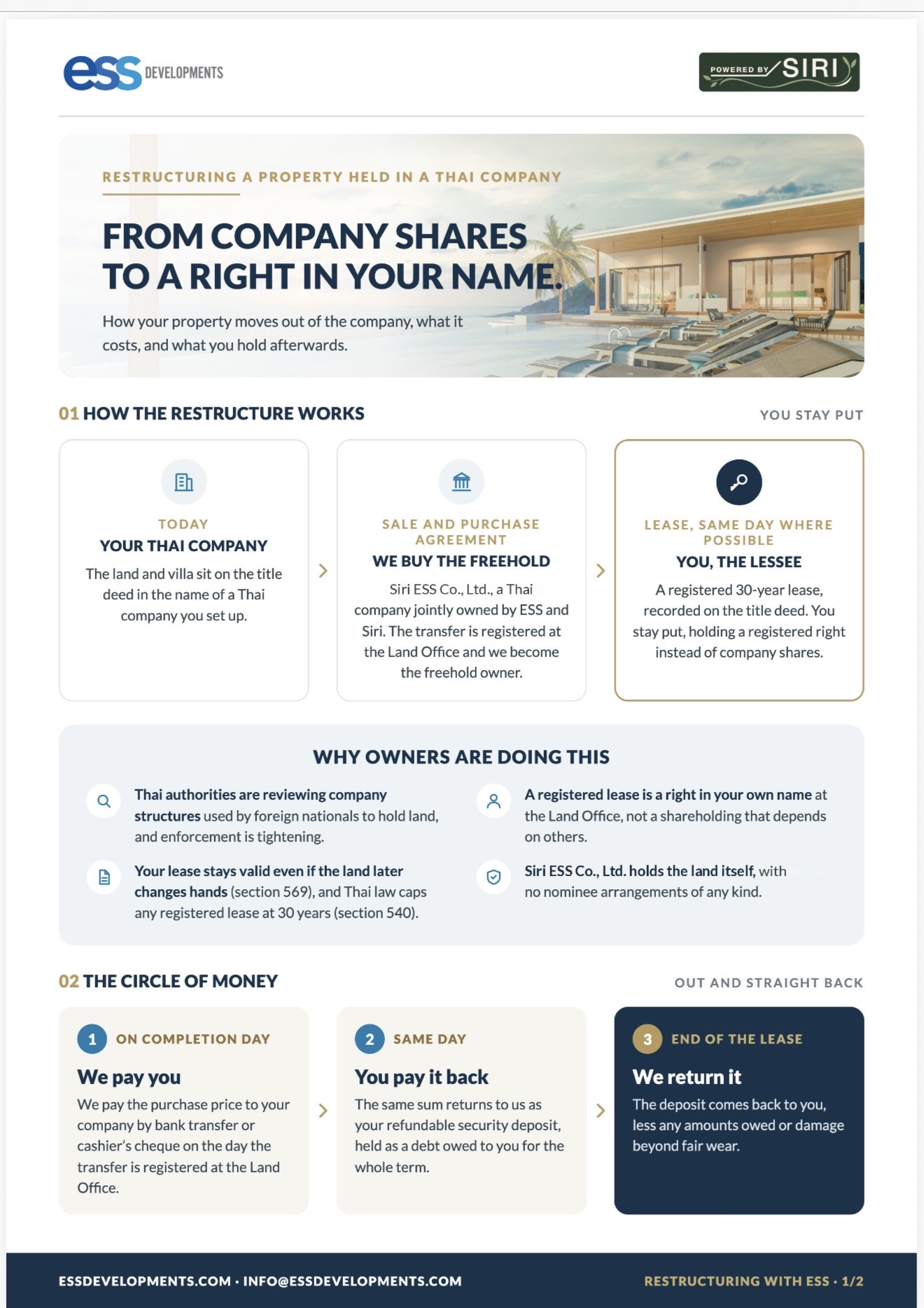
Thai authorities are reviewing company structures used by foreign nationals to hold land, and enforcement is tightening. If you hold your property in a Thai company and do not know what to do with it, we can now help. Read our guide to the Thailand nominee crackdown for what has been announced and who is affected.
Siri ESS Co., Ltd. buys the freehold from your company, the transfer is registered at the Land Office, and you stay put, holding a registered 30 year lease in your own name instead of company shares, on the same day where possible.
The purchase price goes to your company by bank transfer or cashier’s cheque on the day the transfer is registered.
The same sum returns to us as your refundable security deposit, held as a debt owed to you for the whole term.
The deposit comes back to you, less any amounts owed or damage beyond fair wear. It is not a new cost to you.
Transfer costs on the government appraised value, paid by the seller, your company: 2% Land Office transfer fee; business tax 3.3% where held under five years, otherwise stamp duty 0.5%; withholding tax 1%. We check the title deed, mortgages and the building permit before anything starts, your shareholders approve the sale in writing, and we give you exact numbers before anything is signed.
| When | Fee | Paid to |
|---|---|---|
| At lease registration | 1% of total rent across the term | Land Office |
| At lease registration | 0.1% stamp duty | Land Office |
| Monthly lease fee | THB 6,420 including VAT, assessed value up to THB 10,000,000 | Leasing company |
| Monthly lease fee, above THB 10,000,000 | 0.06% of assessed value, plus VAT | Leasing company |
| Payment frequency | Annually in advance standard; quarterly adds 10%, monthly adds 15% | Leasing company |
| Fee review | Every 2 years against Thailand CPI, 60 days notice, can fall as well as rise | n/a |
| Selling or transferring your lease | Fixed fee: THB 100,000 + VAT, adjusted for CPI | Leasing company |
| Selling or transferring your lease | All transfer costs | Land Office and lawyers |
| Subletting | No fee | n/a |
| Inheritance | THB 100,000 + VAT, to register heirs | Leasing company |
| Renewal, a new lease at expiry | THB 100,000 + VAT renewal fee; renewal costs borne by the lessee | Leasing company and Land Office |
| Restructuring only, at transfer | 2% transfer fee, 3.3% business tax or 0.5% stamp duty, 1% withholding, on government appraised value | Land Office and Revenue Department |
Figures exclude VAT where applicable and may change. Fees correct as of November 2026. The signed Lease Agreement prevails. ESS Developments is not a law firm and does not provide legal or tax advice; independent legal advice is recommended.
Understand the ownership structure, costs and rights behind your ESS property lease.
How your property moves out of the company, what it costs, and what you hold afterwards.

Sample layout of a Sap Ing Sith certificate, the blue Garuda. Sample data, for illustration only.
Sap Ing Sith is a real, registered property right, created by the Sap Ing Sith Act of 2019. It is registered on the title deed at the Land Office for a term of 30 years, and the holder is issued with their own certificate, known as the blue Garuda. It is sellable, transferable and inheritable, and as a registered right it binds the property itself, meaning it holds good against any future owner of the land. It remains largely untested in the Thai courts, has seen very limited use nationwide, and many Land Offices still have limited experience registering it, which can add delay to the process. We are happy to register a Sap Ing Sith instead if that is your preference, we simply default to the standard lease for its proven track record.
A usufruct is a registered right to use and enjoy a property, recorded on the title deed at the Land Office, for a term of up to 30 years or for the lifetime of the holder. It is personal to the person it is granted to, so it ends on their death and cannot be sold or passed on. It suits specific personal circumstances rather than investment, and we can advise whether it fits yours.
A genuine, properly structured Thai company can own land and house. Done correctly, this means real shareholders, a genuinely active and trading company, annual accounts, an audit and tax filings each year, with no nominee arrangements of any kind. We assist owners with setting this up properly, and with restructuring and maintaining existing companies so they remain fully compliant.
When the foreign freehold quota in a building is full, you can still acquire a condominium unit on the Thai quota, secured through the same options set out above: a registered lease with special conditions, Sap Ing Sith, usufruct, or a Thai company. You also benefit from Thai quota pricing, which is generally 10 to 15% cheaper than the equivalent foreign quota unit.
The land owner registers a lease in your name at the Land Office for up to 30 years, and it is noted on the title deed. You pay the registration fee and stamp duty once, then the lease fee during the term. You can live in the property, let it for periods of 30 days or more, sell the lease or pass it to your heirs, on the terms set out in your lease.
Siri ESS Co., Ltd., a Thai company jointly owned by ESS Developments and Siri, a 100% Thai-owned entity. There are no nominee arrangements of any kind.
Your lease covers both the land and the villa on it. Both stay registered to the leasing company, and your rights to live in, let, sell and pass on the property come from your registered lease.
No. While your lease runs we cannot sell, mortgage or encumber the land, and that commitment survives any change in shareholders or directors.
We must use best endeavours to transfer the freehold to a party you nominate, at no cost to you, within a 60 day nomination window.
Renewal is not automatic. Thai law does not allow a registered lease to renew itself, so any further term is a new lease agreed and registered at that time. You have first refusal: match a genuine third party offer or negotiate new terms. A renewal is a brand new lease. If a new term is not granted, the leasing company pays you the appraised value of the building at that time.
Yes, by agreement, but not automatically. At the end of the term you have first refusal: you can match a genuine third party offer or negotiate a new lease. A renewal fee of THB 100,000 plus VAT applies and you bear the renewal costs.
Only the first 30 years can be registered. Promises of further automatic terms cannot be relied on as of right, so a “30+30+30” offer is really 30 years plus the chance to agree new terms later. Our lease says this plainly: you get first refusal at the end of the term, not a promised extension.
You can ask in writing at any time. We reply within 30 days and will not refuse unreasonably.
The lease fee unpaid beyond three months is a material breach. Your lease can only be ended by order of a Thai court, and disputes go to arbitration in Bangkok, in English.
On the government assessed value or transaction value. If values are disputed, each side appoints a licensed valuer and the average applies, with a binding third valuer where they differ widely.
Registration costs 1% of the total rent across the full term plus 0.1% stamp duty, paid once at the Land Office. As an example, at THB 6,000 a month for 30 years the total rent is THB 2,160,000, so registration is about THB 21,600 plus THB 2,160 stamp duty.
The main risks are a lease that is not registered on the title deed, a land owner who is free to sell or mortgage the land, unclear rights to the building, promises of automatic renewal, and land held through a nominee company. Check that your lease is registered at the Land Office, that the land owner cannot encumber the land, and take independent legal advice.
Correct, Thai law does not allow foreign nationals to own land. A registered lease is a right in your own name at the Land Office, not a shareholding that depends on others.
All ESS Developments projects across Pattaya, Jomtien and Koh Chang.
Copy the following code to your website, and you can adjust the height and width to suit your design.
<iframe width='600' height='400' src='https://my.matterport.com/show/?m=pddxFNqtEA3' frameborder='0' allowfullscreen allow='xr-spatial-tracking'></iframe>
